EUR €
Krepšelis
0
Maka šaknų nauda: ką iš tiesų ropdo moksliniai tyrimai

Maca root has become one of the better-known botanical ingredients in modern wellness products.
You may have seen it in powders, capsules, drinks, smoothies, and natural vitality supplements. It is often associated with energy, endurance, libido, and overall well-being.
But there is an important question behind the popularity:
What does the research actually say about maca root?
The answer is more interesting than a simple “yes” or “no.”
Maca, scientifically known as Lepidium meyenii, is a plant traditionally cultivated in the Andes of Peru. Modern research has investigated maca for several areas, including sexual function, subjective well-being, physical performance, and other aspects of health.
Some human studies have reported potentially positive effects, particularly around sexual desire and aspects of sexual wellbeing. However, systematic reviews have also pointed out that the number of clinical trials remains relatively small, study quality varies, and stronger research is still needed before broad conclusions can be made.
That distinction matters.
Maca is an interesting ingredient with a long history of traditional use and growing scientific interest—but it should not be presented as a guaranteed solution for fatigue, sexual difficulties, hormonal problems, or any medical condition.
This guide takes a closer look at what maca is, why it is popular, what research has found, how it may fit into a modern wellness routine, and what consumers should consider before choosing a maca-containing supplement.
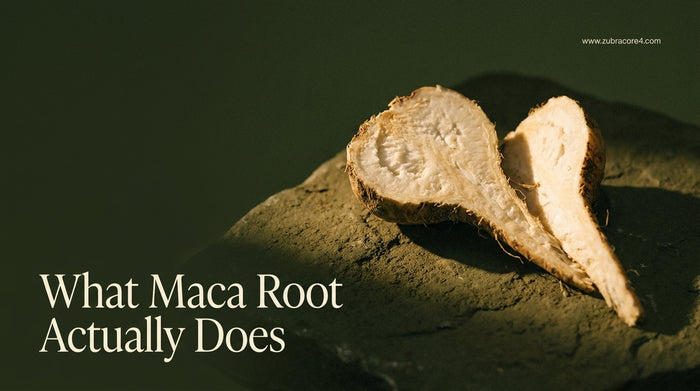
What Is Maca Root?
Maca is a plant native to the high-altitude regions of the Peruvian Andes.
Its scientific name is Lepidium meyenii, and it belongs to the Brassicaceae family, which also includes vegetables such as broccoli, cabbage, kale, and mustard.
The part most commonly used is the root or underground storage organ.
Traditionally, maca has been used as a food and botanical ingredient in Andean communities. Modern products may contain maca as a powder, extract, or standardized preparation.
Maca is sometimes called “Peruvian ginseng,” but that name can be misleading.
Maca is not ginseng.
They are botanically different plants with different chemical profiles.
The nickname mainly reflects maca's reputation as a traditional vitality-supporting botanical rather than a close botanical relationship to Panax ginseng.
Research reviews have identified several groups of compounds in maca, including macamides, macaenes, glucosinolates, and other phytochemicals. Different maca preparations can vary considerably depending on the variety, growing conditions, processing method, and extraction technique.
That variation is one reason why results from one maca study cannot automatically be applied to every maca product on the market.
Why Has Maca Become So Popular?
Maca sits at the intersection of several growing wellness interests.
People increasingly look for botanical ingredients that can complement everyday habits around:
-
Energy
-
Exercise
-
Stress management
-
General vitality
-
Sexual wellness
-
Healthy aging
-
Nutrition
-
Active lifestyles
Maca has attracted particular attention because traditional use and modern research have focused on areas such as energy, sexual function, and physical performance.
However, popularity and scientific proof are not the same thing.
An ingredient can have a long history of traditional use while still requiring modern clinical research to understand exactly how effective it is, for whom it may be useful, what dose is appropriate, and how different preparations compare.
That is the approach consumers should take with maca.
Traditional use can be a reason to study an ingredient. It is not automatically proof of a medical effect.
Maca Root and Energy: What Do We Know?
Energy is one of the most common reasons people become interested in maca.
But “energy” can mean different things.
Someone might mean feeling less tired during the day.
Another person might mean better exercise endurance.
Someone else might mean feeling more motivated or mentally engaged.
These are not necessarily the same biological outcome.
Research on maca has investigated physical performance and fatigue-related outcomes, although much of the evidence is still developing.
A 2024 systematic review and meta-analysis examined studies of maca and physical performance in animals and humans. The researchers found potentially positive effects across several performance-related outcomes, but the evidence base included both preclinical and human research, meaning the findings should not be interpreted as proof that maca will improve athletic performance in everyone.
More recent human research has also explored maca in exercise settings.
For example, a 2025 randomized crossover study involving a small group of trained male basketball players examined maca supplementation in relation to basketball-specific performance and fatigue-related outcomes. Because the study involved only a small sample and a short intervention period, it is better viewed as an interesting piece of evidence rather than a definitive answer.
This is an important lesson when reading supplement research:
One study can raise an interesting question without proving a universal result.
Does Maca Improve Stamina?
The word “stamina” is often used broadly in supplement marketing.
It can refer to physical endurance, exercise capacity, perceived energy, sexual endurance, or simply feeling less fatigued.
Research does not support treating all of these as one outcome.
Some research has investigated maca and physical performance, while other studies have focused on sexual function or subjective wellbeing.
A 2024 systematic review and meta-analysis reported positive findings across several physical-performance outcomes, but the researchers included animal and human studies, and the types of performance tests varied considerably.
Therefore, it would be inappropriate to say that maca is guaranteed to “increase stamina.”
A more responsible way to describe the evidence is:
Maca is being studied for potential effects on physical performance and perceived vitality, but more high-quality human research is needed to determine how meaningful those effects are in everyday use.
That distinction makes wellness content more trustworthy—and gives readers a more realistic understanding of what supplements can and cannot do.
Maca and Sexual Wellness
Sexual wellness is one of the most researched areas surrounding maca.
This is also where marketing claims can easily become exaggerated.
A 2010 systematic review examined randomized clinical trials investigating Maca and sexual function. The review identified only four eligible randomized trials at that time. Some studies suggested potential benefits, while another did not find an effect, and the reviewers concluded that the overall evidence was limited because of the small number of trials, small sample sizes, and methodological limitations.
Since then, additional studies have been published.
One randomized, double-blind clinical trial involving 50 men with mild erectile dysfunction found a small but statistically significant improvement in some measures after 12 weeks of maca supplementation compared with placebo. However, that was one relatively small study and should not be interpreted as evidence that maca treats erectile dysfunction generally.
Other research has looked at women experiencing sexual dysfunction associated with antidepressant use.
A small double-blind placebo-controlled trial investigated 3 grams per day of maca over 12 weeks in women with antidepressant-induced sexual dysfunction. The results suggested potential benefit, but the sample was small and the authors' findings need to be considered alongside the wider evidence base.
A newer 2026 review of maca and sexual health reported generally promising findings in some male studies while describing the evidence in women as more mixed. The review also emphasized that additional research is needed.
So what is the practical takeaway?
Maca is scientifically interesting for sexual wellness, but it should not be marketed as a guaranteed treatment for sexual dysfunction.
Maca and Libido: Is There a Difference?
Yes.
Libido refers broadly to sexual desire or interest.
Sexual function is a wider concept that can include desire, arousal, erectile function, lubrication, orgasm, satisfaction, and other experiences.
A person can have normal physical sexual function while experiencing low desire.
Another person may have strong desire but experience difficulties with another aspect of sexual response.
That is why “maca boosts sexual performance” is an overly broad statement.
Some maca research has specifically examined sexual desire and libido-related outcomes. The evidence is promising enough to justify continued research, but it is not strong enough to support universal promises.
There are also many non-supplement factors that can influence libido, including:
-
Sleep quality
-
Stress
-
Relationship dynamics
-
Mood
-
Physical health
-
Medications
-
Alcohol consumption
-
Exercise
-
Hormonal changes
-
Major life events
This is why a complete wellness approach is more useful than treating one ingredient as the entire answer.
Does Maca Increase Testosterone?
This is one of the claims consumers frequently see online.
The answer requires caution.
Maca is often marketed as a “hormone-balancing” ingredient, but that wording can imply a level of scientific certainty that the available evidence does not necessarily support.
Human research has investigated maca in relation to sexual function and symptoms associated with hormonal aging. One randomized clinical trial in eugonadal men with symptoms of late-onset hypogonadism reported improvements in several questionnaire-based measures after maca treatment. However, individual clinical trials do not establish that maca universally increases testosterone or acts as a hormone treatment.
This distinction is especially important because testosterone levels can be influenced by many factors.
Age, sleep, body composition, illness, medications, exercise, and other health factors can all matter.
Therefore, consumers should be skeptical of supplement claims promising an immediate or dramatic testosterone increase from maca.
A responsible product description should focus on the ingredient's nutritional and traditional context and avoid presenting it as a replacement for medical evaluation.
What Makes Maca Different From Ginseng?
Maca and Panax ginseng are sometimes mentioned together in wellness products, but they are different botanicals.
Maca is an Andean root traditionally used in Peru.
Panax ginseng is an Asian botanical that has a much longer history of traditional use in East Asian medicine.
Their active compounds are also different.
Maca contains compounds including macamides and macaenes, while ginseng contains ginsenosides and other constituents.
This means that the two ingredients should not be treated as interchangeable.
Some wellness formulas combine several botanicals because each ingredient is intended to contribute a different nutritional or traditional role.
But combining ingredients does not automatically mean their effects are additive or guaranteed.
The best approach is to understand each ingredient individually and evaluate the complete formulation separately.
Different Types of Maca
Maca is available in different colors and varieties.
You may come across:
-
Yellow maca
-
Red maca
-
Black maca
These varieties can differ in their phytochemical profiles, and researchers have investigated whether different varieties may have different biological effects.
However, supplement marketing sometimes turns these differences into very specific promises.
For example, you may see claims suggesting one color is exclusively for energy, another is exclusively for hormones, and another is specifically for sexual performance.
The scientific evidence is not strong enough to treat these marketing categories as universal rules.
The more useful question is not simply:
“What color is the maca?”
Instead, ask:
-
What species is being used?
-
Is it powder or extract?
-
How much is provided?
-
Is the ingredient clearly listed?
-
Is the preparation standardized?
-
Does the manufacturer provide quality information?
-
Are there unnecessary proprietary blends?
-
Are the claims realistic?
Transparency is usually more useful than flashy promises.
Maca Powder vs. Maca Extract
Maca can appear in supplements as whole-root powder or as an extract.
These are not necessarily equivalent.
A powder may contain the broader nutritional components of the processed root.
An extract may be processed differently and potentially concentrated in certain compounds.
This matters because studies often specify the exact form and amount used.
If a clinical study uses a particular extract, you should not automatically assume that a completely different maca powder will produce the same result.
This is one of the most overlooked issues in supplement research.
The ingredient name alone does not tell you everything about the preparation.
Consumers should therefore look beyond the front of the bottle and examine the Supplement Facts or ingredient panel.
What Does the Research Actually Show?
When looking at the evidence as a whole, several themes emerge.

1. Maca is scientifically interesting
There is enough preliminary research to justify continued investigation.
Studies have explored sexual function, libido, wellbeing, physical performance, and other areas.
2. Some human studies have reported positive findings
Certain clinical trials have observed improvements in sexual or wellbeing-related outcomes.
3. The evidence is not uniform
Systematic reviews have highlighted limited trial numbers, small sample sizes, differences between preparations, and methodological limitations.
4. Physical-performance research is still developing
Recent systematic-review evidence is encouraging but includes substantial preclinical research, while some human studies remain small.
5. More research is needed
That may sound less exciting than a bold marketing claim, but it is the scientifically responsible conclusion.
Good supplement content does not need to promise certainty.
It needs to explain what is known, what is uncertain, and where the ingredient may reasonably fit into a wellness routine.
Maca Root Side Effects and Safety
Maca has been consumed traditionally as a food and has been studied in human trials.
However, “natural” does not automatically mean “risk-free.”
The most commonly reported side effect is an upset stomach, according to WebMD's maca overview. Allergic reactions are rare but possible: if you notice swelling or difficulty breathing, stop and seek help straight away. WebMD also notes that interactions between maca and medicines are not fully understood.
A 2024 review in Frontiers in Pharmacology (Ulloa del Carpio et al.) concluded that maca is generally safe, with rare adverse effects, based on low toxicity in preclinical studies and good tolerance in people. It also noted that the US Pharmacopeia review found no serious adverse events for single-ingredient maca products, while some concentrated extracts made outside traditional preparation methods still need further evaluation.
Safety can depend on:
-
The amount consumed
-
The form of maca
-
Other ingredients in a supplement
-
Individual health conditions
-
Medications
-
Pregnancy or breastfeeding
-
Allergies
-
The quality and contamination controls of the product
Some clinical studies have reported that maca was well tolerated during the study period, but individual trials cannot establish that every maca product is appropriate for every person.
If someone has a medical condition, takes prescription medication, is pregnant or breastfeeding, or is experiencing persistent symptoms, speaking with a qualified healthcare professional is a sensible step before starting a new supplement.
How Long Does Maca Take to Work?
This is another question where online marketing can become misleading.
There is no universal scientifically established timeline that applies to everyone using maca.
Clinical studies have often measured outcomes over several weeks rather than treating maca as an instant-acting product.
For example, some clinical trials have evaluated outcomes after 12 weeks of supplementation.
That does not mean everyone needs exactly 12 weeks or that a person will definitely notice an effect after that period.
It simply shows that research outcomes are often assessed over sustained periods rather than assuming an immediate effect.
If a product promises dramatic results within minutes, consumers should examine that claim separately from the evidence surrounding maca itself.
How People Use Maca
Maca is usually taken daily, as a food, a powder or part of a blend. Any effects tend to build gradually rather than appear instantly, so it works best as part of a consistent routine rather than a one-time dose.
If you take medication or manage a health condition, check with a healthcare provider before adding it to your routine.
What should you look for in a maca product?
Not all products are equally transparent.
When evaluating a product that contains maca, look for:
Clear ingredient disclosure
The label should identify what ingredients are actually included.
Avoid unnecessary proprietary blends that hide individual ingredient amounts.
Clear serving information
Consumers should be able to understand how much of each relevant ingredient they are getting.
Realistic claims
Be cautious of language such as:
-
“Guaranteed results”
-
“Instant testosterone boost”
-
“Cures erectile dysfunction”
-
“Permanent libido enhancement”
-
“Works for everyone”
-
“Medical replacement”
These claims go far beyond what responsible evidence-based supplement communication should promise.
Quality information
Look for information about manufacturing standards, testing, sourcing, and product quality where available.
Transparent brand communication
A trustworthy wellness brand should be willing to explain what its product contains rather than relying entirely on dramatic marketing language.
Where Maca Fits Into a Modern Wellness Routine
Maca should be viewed as one possible component of a broader lifestyle rather than a substitute for healthy habits.
Think about the foundation first.
Sleep
Consistent, adequate sleep is important for energy, mood, recovery, and overall wellbeing.
Physical activity
Regular movement can support cardiovascular health, fitness, mood, and daily energy.
Nutrition
A varied diet provides the nutrients required for normal physiological function.
Stress management
Chronic stress can affect sleep, mood, relationships, and perceived energy. Read more in how stress affects energy, confidence and intimacy.
Emotional connection
Relationships and intimacy are influenced by communication, trust, stress, confidence, and physical wellbeing—not just supplements.
Using maca sensibly
Maca can sit alongside a healthy routine, but it should not replace the foundation.
This broader approach also makes the way maca products are marketed more credible.
Instead of saying:
“Maca solves your stamina problems.”
A more responsible approach is:
“Maca is a traditional botanical that has been studied for areas including physical performance and sexual wellbeing, although research remains developing.”
That gives the reader useful information without promising an outcome.
Where ZubraCore4 Fits In
ZubraCore4 includes maca root as part of a broader honey-based food blend. The brand describes its blend as natural and includes ingredients such as maca root, Panax ginseng, royal jelly, and bee pollen.
That means maca is one component of the overall blend rather than the entire product story.
Maca is rarely used on its own. It is often combined with other traditionally used ingredients, such as ginseng and bee pollen, as part of a broader daily routine. That is the idea behind ZubraCore4: several traditional ingredients in one honey-based food blend, with all 12 ingredients listed openly.
From a wellness perspective, this distinction matters.
A complete routine can include:
Quality sleep + regular movement + balanced nutrition + stress management + emotional connection + considered food choices
Any single product should complement those habits rather than replace them.
For readers interested in maca specifically, the ingredient can be evaluated on its own scientific evidence.
For readers considering ZubraCore4, the more relevant question is how the complete blend fits into their personal wellness routine.
The product should also be evaluated based on transparent labeling, ingredient amounts, quality information, and realistic expectations.
“ZubraCore4 ingredients” “Foods for stamina”
You can see the packs on the ZubraCore4 facts page.
Maca Is Not a Replacement for Medical Care
There is an important difference between supporting general wellness and treating a health condition.
If someone experiences persistent fatigue, changes in sexual function, low libido, pain, unexplained changes in health, or other ongoing symptoms, the right approach is to investigate the underlying cause.
For example, fatigue can have many possible causes.
Likewise, changes in sexual function can involve psychological, relationship, neurological, vascular, hormonal, medication-related, or other health factors.
A supplement may be part of someone's wellness routine, but it should not be used to avoid appropriate medical assessment.
This is particularly important when symptoms are new, persistent, severe, or causing significant distress.
Common Maca Marketing Claims: What to Think About
Let's take a closer look at some common statements.
| Marketing Claim | More Responsible Interpretation |
|---|---|
| “Maca boosts testosterone instantly.” | Evidence does not justify a universal instant-testosterone claim. |
| “Maca cures erectile dysfunction.” | Clinical evidence is limited and maca should not be presented as a medical cure. |
| “Maca guarantees more libido.” | Individual responses vary and research findings are not universal. |
| “Maca gives everyone more energy.” | Energy-related research is still developing and outcomes vary. |
| “Maca works immediately.” | Many clinical studies evaluate outcomes over weeks rather than minutes. |
| “Maca is completely risk-free.” | Natural ingredients can still have individual safety considerations. |
The lesson is simple:
Good supplement marketing should explain rather than exaggerate.
Maca vs. Lifestyle: Why Both Matter
Imagine two people.
Person A sleeps five hours a night, rarely exercises, eats irregularly, feels constantly stressed, and expects one supplement to completely transform their energy.
Person B gets consistent sleep, stays physically active, eats a balanced diet, manages stress, maintains healthy relationships, and views supplementation as an optional addition.
The same ingredient may be experienced very differently in those two contexts.
This is why wellness should be approached as a system.
There is no single ingredient that can replace the fundamentals of healthy living.
Maca can be an interesting botanical within that system, but it is not the system itself.
Frequently Asked Questions
What is maca root?
Maca root comes from Lepidium meyenii, a plant traditionally cultivated in the Peruvian Andes. It belongs to the Brassicaceae family and is commonly consumed as a food ingredient or dietary supplement.
What are the most researched benefits of maca?
Research has investigated maca in areas including sexual function, libido, wellbeing, and physical performance. Some studies report potentially positive effects, but the overall evidence remains limited in several areas.
Can maca increase energy?
Maca has been studied for physical performance and fatigue-related outcomes, but evidence is still developing. It would be inappropriate to guarantee increased energy for every person.
Can maca support sexual wellness?
Some human studies have reported improvements in sexual desire or aspects of sexual wellbeing, but systematic reviews have described the overall evidence as limited or mixed.
Does maca increase testosterone?
Maca is frequently marketed for hormonal support, but this should not be confused with established testosterone treatment. Research does not justify a blanket promise that maca will dramatically or immediately increase testosterone.
Is maca the same as ginseng?
No. Maca and Panax ginseng are different plants with different chemical profiles and traditional uses.
How long does maca take to work?
There is no single timeline that applies to everyone. Human trials have often assessed maca over several weeks, including 12-week interventions.
Can women use maca?
Maca has been studied in women as well as men. Some research has explored sexual wellbeing and other outcomes in women, although findings are not uniformly positive and more research is needed.
Is maca safe for everyone?
No supplement should automatically be considered appropriate for everyone. People with medical conditions, those taking medications, and people who are pregnant or breastfeeding should consider discussing supplementation with a qualified healthcare professional.
Is maca root a stimulant?
No. Maca is a root vegetable and naturally contains no caffeine, so it isn't a stimulant in the way coffee or energy drinks are. Research on energy and mood is still limited. As with any food that is new to you, notice how it suits you, and speak with a healthcare professional if you take medication.
Is maca a treatment for erectile dysfunction?
Maca should not be presented as a proven treatment or cure for erectile dysfunction. Some small clinical studies have reported potentially positive findings, but the overall evidence remains insufficient for broad treatment claims.
The Bigger Picture
Maca is a fascinating example of how traditional botanical knowledge and modern scientific research can meet.
It has a long history of use in the Andes and has attracted modern research because of its potential relationship with areas such as sexual wellbeing, physical performance, and general vitality.
But the most useful takeaway is not that maca is a miracle ingredient.
It is that maca is an ingredient worth understanding carefully.
Research suggests potential benefits in some areas, particularly sexual wellbeing and certain measures of physical performance, but the evidence is not strong or consistent enough to justify universal promises. Systematic reviews continue to call for larger, better-designed human studies.
For consumers, that means looking beyond bold claims.
Check the ingredient.
Check the amount.
Check the formulation.
Check the quality information.
Look for realistic expectations.
And remember that supplements work within the context of a person's broader lifestyle and health—not independently of it.
For ZubraCore4, maca is one part of a broader honey-based blend designed around natural vitality and wellness. It can be discussed as an ingredient with an interesting research background without claiming that it can solve every energy or intimacy concern.
That is ultimately what responsible wellness content should do:
Give people useful information, explain the evidence honestly, and let them make informed choices.
Final Takeaway
Maca root has moved from a traditional Andean food and botanical ingredient into the modern wellness market.
Research has explored its potential relationship with sexual desire, sexual wellbeing, physical performance, and other outcomes. Some findings are encouraging, but the overall evidence remains developing.
So if you are considering maca, think beyond the marketing headline.
Instead of asking:
“Will maca guarantee a specific result?”
A better question is:
“What does the research actually show, what are the limitations, and how does this ingredient fit into my overall wellness routine?”
That approach leads to better decisions—and better supplement education.
Maca may be an interesting addition to a broader approach to everyday vitality, but sleep, movement, nutrition, stress management, relationships, and appropriate healthcare remain important parts of the bigger picture.
Editorial Note
This article is intended for general educational purposes and is not medical advice. Research on maca varies by preparation, population, dose, and outcome studied. Findings from individual studies should not be interpreted as proof that a specific maca product will produce the same results. If you have persistent symptoms, take medication, have an existing medical condition, or have concerns about sexual or general health, consult a qualified healthcare professional.
This article is for general education only and isn't medical advice. ZubraCore4 is a honey-based food blend, not a medicine, and is not intended to diagnose, treat, cure or prevent any disease. If you have a medical condition or take medication, speak with a healthcare professional before use.